A visual illusion written in motion
Ghost Font is not a font file. It is a motion-based experiment built from a black-and-white field of random points. Dots inside the letter mask travel against the background, so the visual system discovers a word from their relative movement.
Pause the field and the target phrase falls back into an ordinary-looking frame of noise. A faint layer of decoy text further breaks up stable letter shapes; the intended message lives in the change between frames.
From a phrase to motion-only type
Choose the hidden phrase
Enter a concise phrase. The generator turns it into a hidden letter mask inside a fresh black-and-white random-point field.
Shape the counter-motion
Adjust the speed, invert the field, or remix the dots. The background and masked points automatically move against each other.
Record the illusion
Record the moving field in your browser and download a short video that preserves the reveal.
Where Ghost Font still challenges AI
Most OCR pipelines begin with stable contrast, edges, and character shapes. Ghost Font removes many of those stationary clues. A paused frame gives the masked area the same random-dot texture as its surroundings, while the readable boundary emerges only when the two fields move apart. This creates a temporal perception problem, not merely a difficult picture.
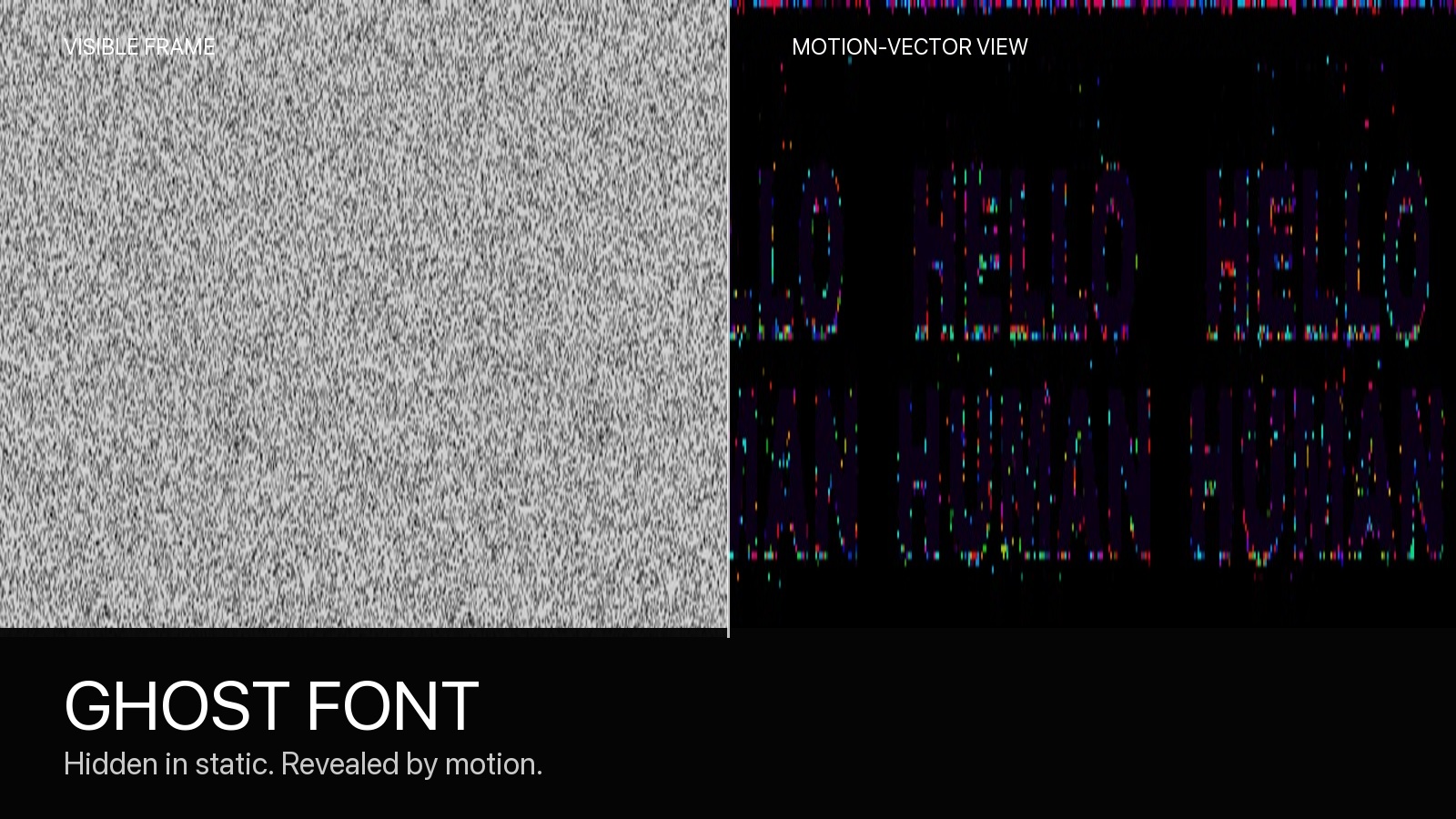
Some screenshot-first AI and OCR workflows may return noise, follow the faint decoy, or guess the wrong phrase. Our 159-frame case study shows why: inspected stills and ordinary frame differences did not expose readable letters. That is evidence of a pipeline mismatch, not proof that AI cannot read Ghost Font across every phrase, speed, dot field, frame rate, or compression setting.
The same case also shows how machines can answer back. Exported H.264 motion vectors repeatedly revealed HELLO HUMAN after background motion was removed and vector direction was visualized. Codec analysis, optical flow, and purpose-built temporal models can look where screenshot OCR does not. Ghost Font remains a revealing perception experiment, but it should never be trusted as permanent secrecy.
Why human vision sees a word in noise
Human vision is unusually sensitive to change over time. Instead of identifying every dot, the brain groups points that share a direction and notices the boundary where one motion pattern meets another. That moving boundary supplies enough structure for letters to emerge. Freeze the canvas and the temporal relationship disappears, leaving a dense texture with few stable outlines to follow.
The effect varies by viewer and display. Speed, dot density, phrase length, screen size, compression, playback smoothness, and reduced-motion settings can all change legibility. Short, bold phrases usually create the clearest reveal, while a small player or dropped frames can weaken it. That variability is part of the experiment, which is why the generator lets every viewer tune the motion instead of pretending one setting fits every eye.
What can you make with Ghost Font?
Ghost Font works best when surprise matters more than instant readability. Use it for experimental typography, title cards, digital art, motion posters, classroom demonstrations, puzzles, or social clips. It also suggests a functional experiment: a motion CAPTCHA in which a person reads a short phrase carried by counter-moving dots while common screenshot-based AI or OCR may see only noise.
A Ghost Font CAPTCHA should remain experimental. Recognition varies with eyesight, motion sensitivity, display size, playback quality, and reduced-motion preferences, creating serious accessibility concerns. Purpose-built software may recover the mask through codec motion vectors, optical flow, or other temporal analysis. If tested in authentication, provide an accessible alternative and combine it with rate limiting, risk scoring, and server-side checks. Never use Ghost Font as the sole security control. For creative work, keep phrases concise and preview the motion at its intended size.
Project identity
GhostFont.org is an independently designed and operated browser project. The public experience, visual identity, and educational content are maintained by this project.
An illusion, not a lock
Ghost Font does not encrypt, conceal, or securely transmit a message. Anyone who can play the video may perceive the phrase, and the effect does not protect the same text if it is shared elsewhere.
A single frame is designed to obscure the target for human vision, but that does not guarantee resistance to OCR, AI, frame analysis, or future tools. Treat it as creative media, not a reliable security control.
Questions about the illusion
What is Ghost Font?
Ghost Font is a browser-based motion illusion, not a traditional font or downloadable typeface. It uses moving random points to make a masked phrase perceptible over time.
How does the motion illusion work?
The background points and the points clipped by the letter mask move in opposing directions. Your visual system detects that changing boundary and assembles it into readable letterforms.
Why does the phrase disappear when paused?
The target phrase is encoded in relative movement rather than a stable outline. Stop that movement and the dots return to a visually similar noise field, softened further by faint decoy text.
Can Ghost Font reliably block AI or OCR?
No reliable protection should be assumed. In our 159-frame case study, ordinary still inspection failed, but H.264 motion-vector analysis recovered HELLO HUMAN. Other clips may respond differently to frame analysis, optical flow, re-encoding, or future video models, so never treat the effect as secure.
Does it run locally, and do I need an account?
Yes, the field is generated and the short video is recorded locally in your browser. The generator does not require an account or upload your phrase to create the result.
What does the generator download?
The generator records the moving illusion and downloads it as a short video. A video preserves the counter-motion that makes the target phrase visible; a still image does not.